

![Best Portable Solar Chargers for Backpacking & Bikepacking [2026]](https://bikehikesafari.com/wp-content/uploads/2022/03/Best-Portable-Solar-Charger.jpg "Best Portable Solar Chargers for Backpacking & Bikepacking [2026]")
Carrying a solar panel only makes sense if the trip is long enough that the panel weighs less than the batteries it replaces, and that is a calculation most reviews skip.
This guide is for backpackers, thru-hikers and bikepackers who need to keep a Smartphone, Hiking GPS, Hiking Watch, Emergency PLB, and Hiking Camera alive for a week or more between resupplies, not for anyone looking to run a fridge at a campsite. When combined with a a Lightweight Backpacking Power Bank your electronics could potentially stay charged indefinitely.
Over more than 30 years of long-distance hiking and bike touring, plus several years managing a hiking retail store, I have watched solar go from a gimmick to something genuinely worth the grams on the right trip.
My current top pick for 2026 is the Big Blue Solarpowa 28W Solar Charger, with the FlexSolar E10 Mini as the best ultralight option at around 9 oz. The trade-off to understand is watts against grams, because more panel means faster charging and a heavier pack.
Start with the Quick Picks below. For how I research and field-test gear, see the Gear Review Policy.
Quick Picks: Best Backpacking Solar Charger
- Best overall: Big Blue Solarpowa 28W Solar Charger – 28W rated with USB-A and USB-C at 0.67 kg, and the ammeter version is the only panel here that shows you live output so you can angle it properly. The best balance of charging speed and carry weight for a two person trip.
- Best ultralight: FlexSolar E10 Mini – around 9 oz for a 10W panel, which is the lowest weight penalty in the category. Enough to keep a phone and watch alive on a thru-hike if you top up at every lunch break.
- Best for thru-hiking: Biolite SolarPanel 10+ 2.0 – the integrated 3,200 mAh battery means the panel banks power while you walk and you charge the phone at camp, which removes the biggest practical annoyance of solar.
- Best budget: Blavor 10W – a genuinely cheap 10W folding panel with USB-A and USB-C at around 12.6 oz.
- Best for bikepacking and bike touring: FlexSolar 20W – IPX67 rated, eyelets on every corner and 14 oz, so it survives rain and straps flat to a rear rack or a handlebar bag without fuss.
- Best for couples and small groups: Anker Solix PS30 30W – two fast ports and enough output to keep two phones and a power bank topped up. At 1,077 g it is heavy, so split it between two packs.
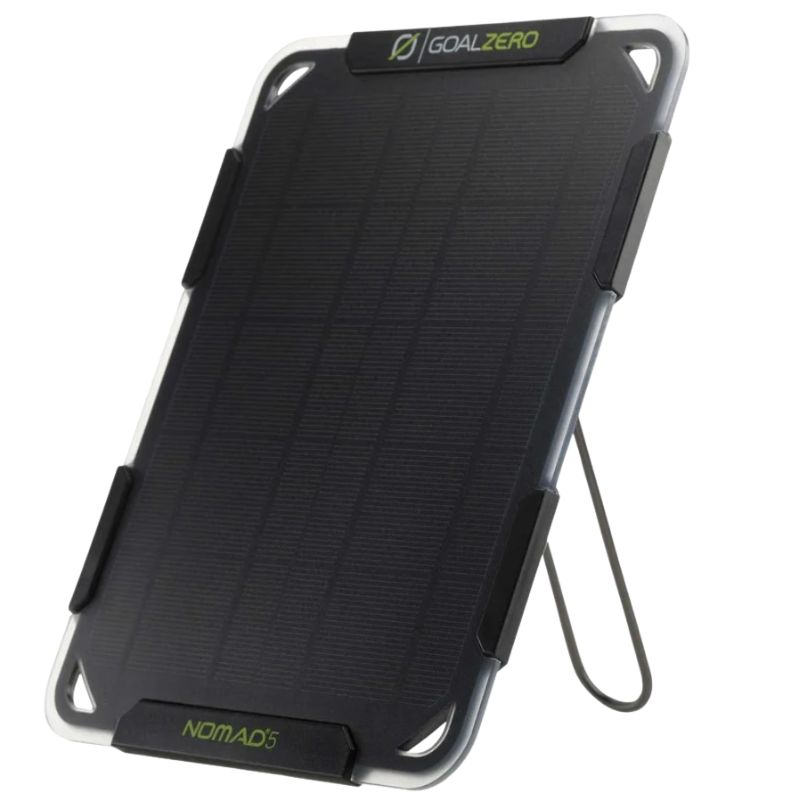
- Best lightweight rigid panel: Goal Zero Nomad 5 – 12.4 oz, kickstand legs and a build that shrugs off being set down on rock. Slow at 5W, but very hard to break.
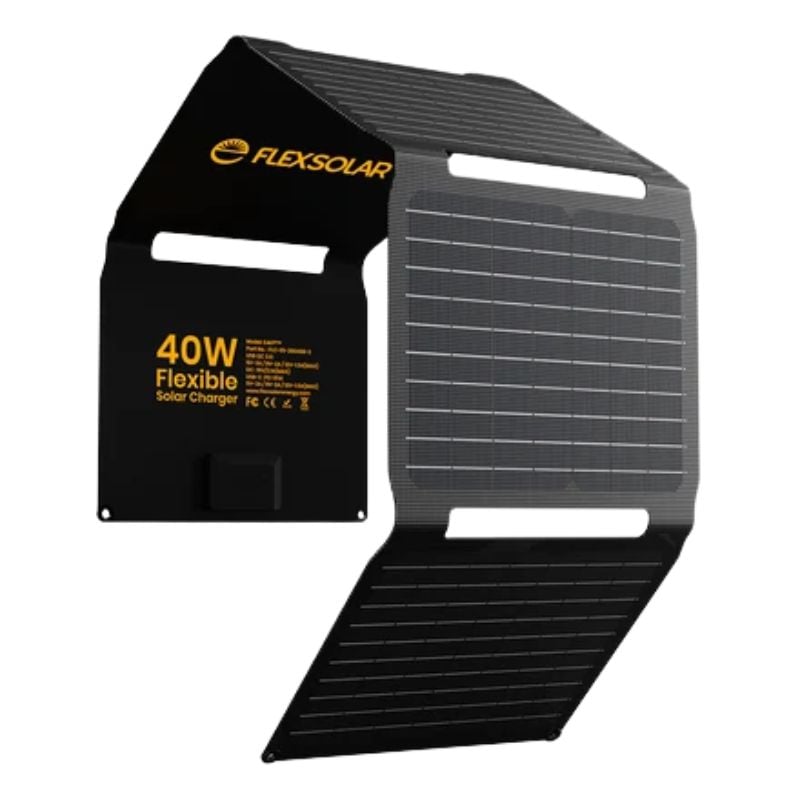
- Best for basecamp and bike touring with a power station: FlexSolar 40W – 26.1 oz with a DC output, so it can feed a small power station. Too heavy to backpack, ideal for a fixed camp or a fully loaded touring rig.
How We Tested
The portable solar chargers in this guide are researched and, where possible, field-tested by an experienced long-distance hiker and former outdoor store manager with more than 30 years of thru-hiking, backpacking and bike touring experience. Across thru-hikes, shoulder-season trips and bikepacking trips, I judge portable solar chargers on real world output per gram carried, packed size and how they ride on a pack or a rear rack, weather resistance, port layout and charging speed, durability, and value for serious backpacking. Some of the items were supplied by the manufacturer and some items were purchased by the author for this review. For more on how we research and review gear, see the BikeHikeSafari Gear Review Policy.
Follow along on Social Media
Backpacking Solar Charger Comparison Table
Best Portable Solar Chargers for Backpacking 2026
Best Portable Solar Charger – Overall
Big Blue Solarpowa 28W Solar Charger
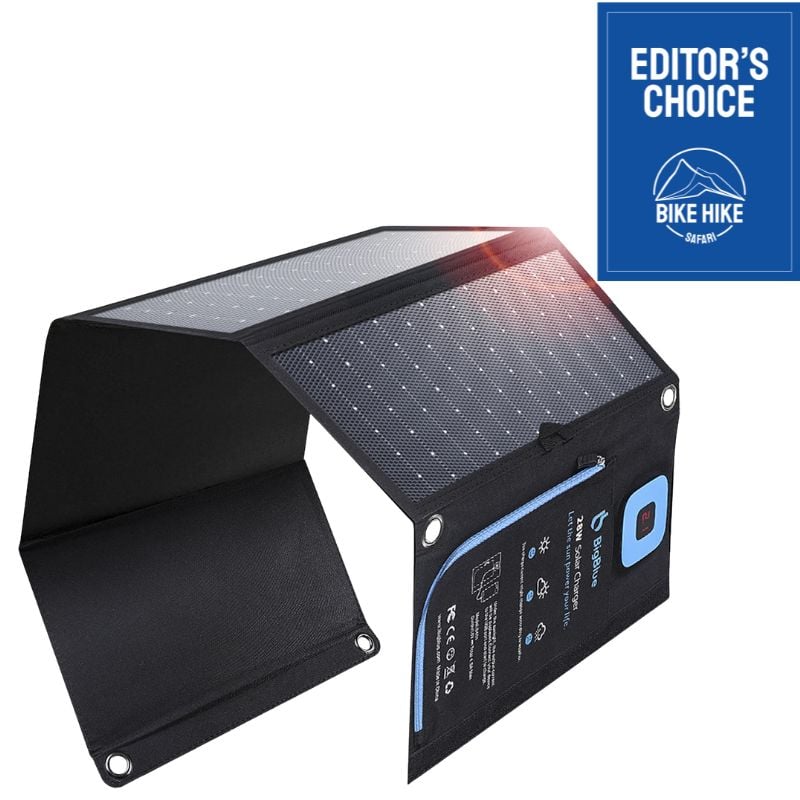
Weight: 1 lb. 7.3 oz / 670 grams
Pros:
> 1 x USB-A and 1 x USB-C port.
> Can be folded down, for easy storage and portability.
> Solar Panel has a PET polymer surface, which protects them from rain or any kind of moisture.
Cons:
> You need to put the solar panel in direct sunlight if you want it to charge quickly. It will charge in the shade, but the device will just take longer to charge up.
This is the panel I keep coming back to as one of the highest output panels in this review. The updated SolarPowa 28 replaced my previous favorite the BigBlue 3 and the new model runs one USB-A and one USB-C, which is the better arrangement now that most phones, watches and satellite messengers use the more common USB-C. There is a two version, one with a built-in ammeter and one without, the built in ammeter in this review is the better option in my opinion. Being able to see live amps while you tilt the panel is the fastest way to learn that a panel lying flat on the ground is throwing away a third of its output.
At 670 g it is a real weight decision. On a solo trip with a resupply every four or five days I would leave it home and carry a bigger battery power bank instead. On a longer stretch, or with two or three people sharing it, the maths flips and it earns its place. It is also a good bikepacking panel, since it straps flat across a rear rack or handlebar bag.
The honest limitation is the same as every panel here. In shade or heavy overcast it still charges, but slowly enough that you should plan around banking power at lunch stops and at camp rather than while walking.
Trade off: 670 g of carry weight for one of the fastest charging in this guide.
Best for: two or three people sharing one panel on a long trip, and bikepacking rigs with rack space.
Best Ultralight Portable Solar Charger
FlexSolar E10 Mini
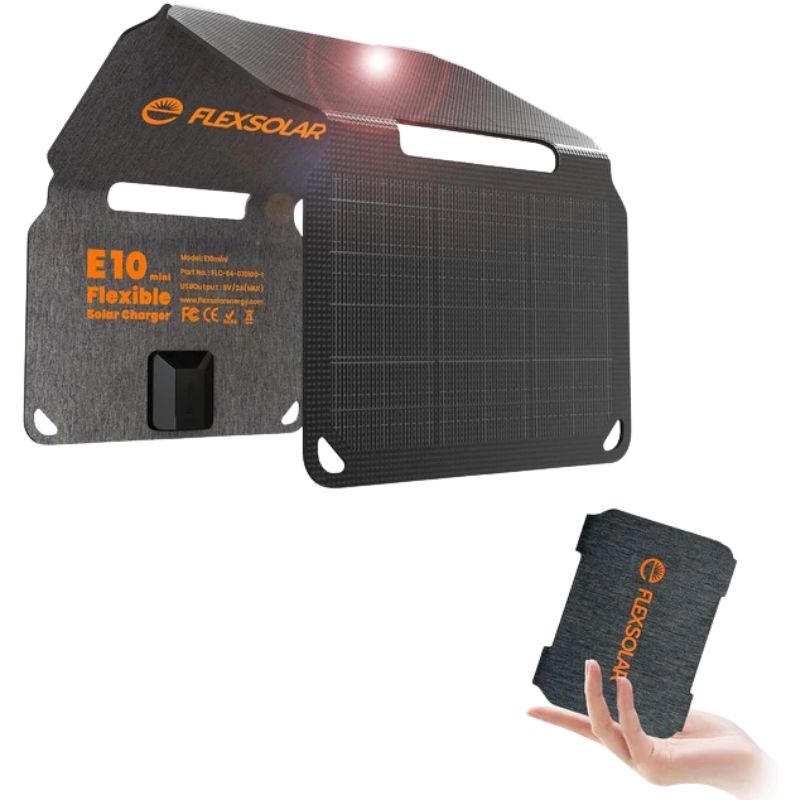
Weight: 9.1 oz / 258 grams
Pros:
> Ultralight
> Very compact size
> IP67 waterproof
Cons:
> Doesn’t feel as strong as some other panels
> Some hikers may need to pair it with a portable power bank for extra energy
This is the portable solar panel that is finally an option for ultralight thru-hike. At 9.1 oz it is roughly the same weight as a 10,000 mAh ultralight power bank, and unlike the power bank it does not run out unless there is no sun.
It suits the trips where solar makes the most sense: long carries between towns, high open country, and summer through early autumn when the days are long. On the Te Araroa’s forest sections or a wet Fiordland week it will struggle, and no panel this small will save you there. In open alpine or desert terrain of the PCT or CDT it will keep a phone in airplane mode and a GPS watch running indefinitely.
Set against the bigger panels, the compromises are real. One USB-A port only, so no simultaneous charging and no USB-C without an adapter, and it needs a power bank alongside it because there is no onboard battery. Expect the better part of a full sunny day of exposure to bank one phone charge. That is fine if you clip it onto your backpack in the morning and forget about it.
Durability is the open question with any panel this thin. Treat the hinges gently and do not fold it against grit.
Trade off: the lowest weight penalty in the category, but only one port and slow absolute output.
Best for: solo ultralight thru-hikers who want a trickle of power that never runs dry.
Best Thru Hiking Solar Power Charger
Biolite SolarPanel 10+ 2.0
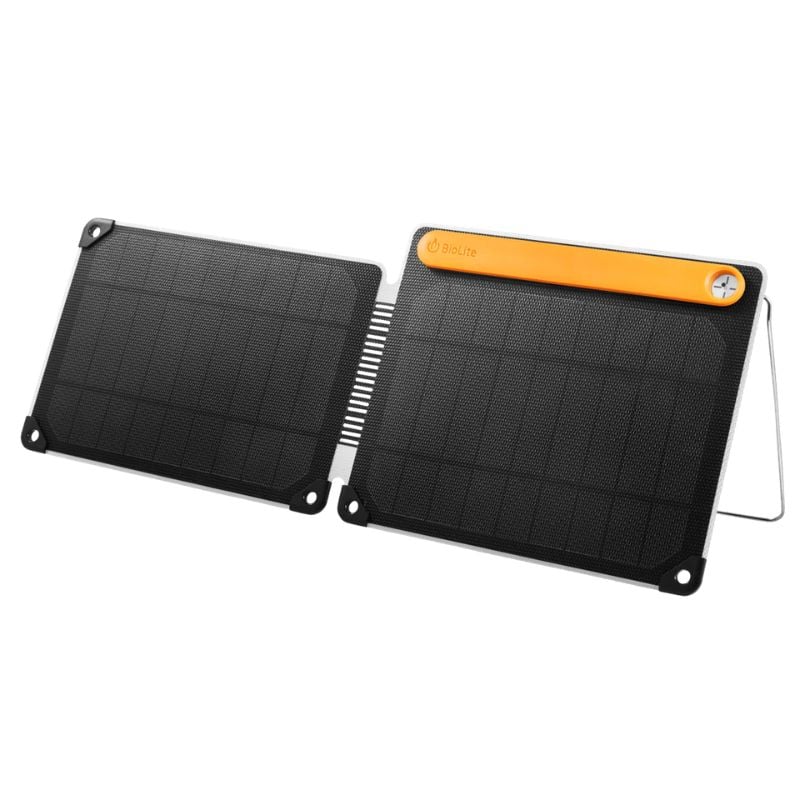
Weight: 1 lb. 3.4 oz / 550 grams
Pros:
> Comes with a kickstand that allows you to position the product perfectly towards the sun.
> A built-in sundial allows you to precisely angle your charger at the sun
> Has an integrated battery pack that will take only 2 hours to recharge itself.
Cons:
> This is a pricey product, and one of the more expensive ones on our list today.
The 10+ 2.0 solves the problem that makes people give up on solar. With a bare panel you have to be near the panel while it works, or trail a cable to a power bank and hope nothing overheats. With the onboard 3,200 mAh battery the panel does its job unattended and you charge the phone at camp from a regulated battery instead of a fluctuating panel.
The 10+ gets the battery charged and your phone charged within a couple of hours in the sun. The kickstand with the built-in sundial is not a gimmick either. Angling a panel properly is worth more than a few extra rated watts, and the sundial makes it quick.
For trips, this is the pick for multi-day and thru-hiking use where you set camp in the afternoon with sun still on the ground. Strap it to the pack while walking and it will collect something, but the honest reality across every panel I have used is that on-the-move charging is unreliable. Treeline Review reached the same conclusion in their testing.
At 550 g it is not ultralight, and IPX4 means splash resistant rather than waterproof, so it goes inside the pack when the rain starts.
Trade off: 550 g and only splash resistance, in exchange for the most usable real world workflow here.
Best for: thru-hikers and multi-day backpackers who want power banked without babysitting a cable.
Best Budget Solar Charger
Blavor 10W
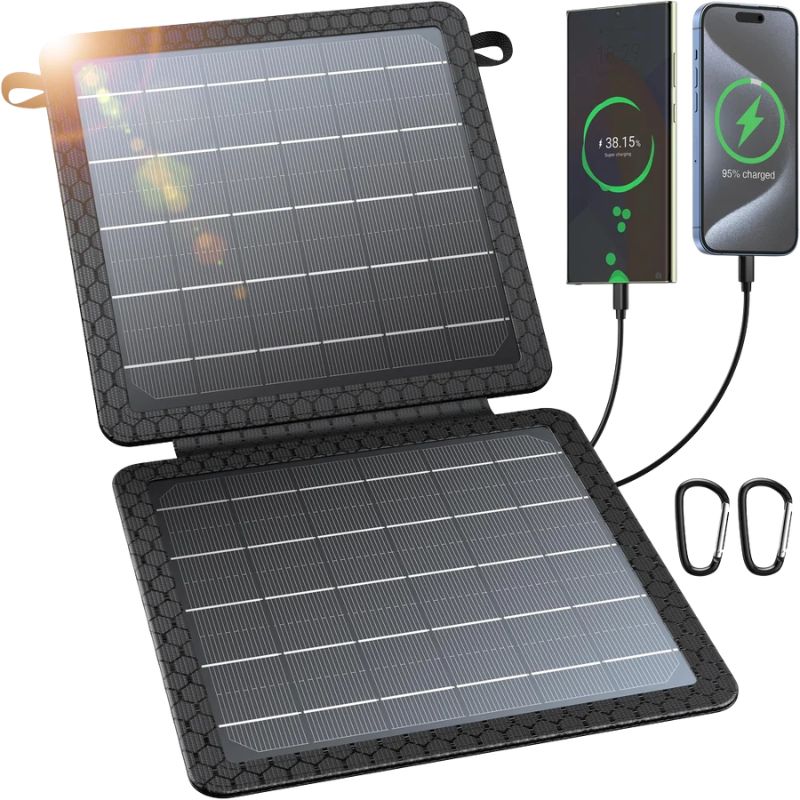
Weight: 13 oz / 370 grams
Pros:
> USB-A and USB-C ports
> Can be folded down, for easy storage and portability.
> Reasonably priced
Cons:
> Not as durable some other solar panels
The Blavor 10W folding panel with both USB-A and USB-C, no onboard battery, and a price low enough that you can find out whether solar suits your trips without a large outlay. That is exactly what I would recommend to someone who has never carried a panel before and is not sure they will use it twice.
For trip type it sits in the same bracket as the E10 Mini but with a bit more panel area and a bit more weight. Summer backpacking, bike touring, and shoulder-season trips in open country all work. It is not the panel for a wet forest thru-hike, and neither is anything else at this size.
The compromises are the usual budget ones. Build quality and materials are a step below the BigBlue and BioLite, the fabric and stitching are the parts I would expect to wear first, and warranty support from budget brands is not comparable to Goal Zero or BioLite. Pair it with a 10,000 mAh bank and keep it out of the rain.
Trade off: budget build and no onboard battery, but strong output for the weight and price.
Best for: first-time solar users and anyone testing whether a panel earns its place in the pack.
Best Bikepacking Solar Charger
Flexsolar 20W Solar Panel Charger

Weight: 14 oz / 398 g
Pros:
> Ultra lightweight Solar Charger
> IPX67 Rated – These Solar panels can withstand dust and water
> Eyelets on the corners can be used to attach this product to a tree, tent, or backpack for convenient solar charging.
Cons:
> Not as powerful as some of the other chargers
This is a foldable yet lightweight panel that charges up to two devices directly, and the IPX67 rating means these solar panels can withstand dust and water. That last point is what moves it to the top of the bikepacking list. Bikes get rained on and panels strapped to a rack take spray off the road, and most panels in this class are rated splash resistant at best.
At 14 oz for 20W the output per gram is good, sitting between the 10W ultralight options and the 670 g BigBlue. The corner eyelets are genuinely useful on a bike. You can lash it flat across a rear rack top, over a saddlebag, or across the top of a handlebar roll, and it stays put on rough surface without flapping.
For trips, this is my pick for bike touring and bikepacking, and a reasonable choice for backpacking if you want more than 10W without going over a pound. You can charge devices such as smartphones, cameras, tablets and GPS all using the sun’s rays through the USB ports.
Two things to plan for. There is no power bank included with this unit, so take one, and pair it with a Lightweight Bikepacking Power Bank rather than charging the phone directly off the panel. And while FlexSolar claims tablet and small laptop charging, treat that as optimistic outside of ideal midday sun.
Trade off: no onboard battery and mid-pack output, but the best weather resistance per gram here.
Best for: bikepacking, bike touring and wet-climate trips where the panel will get rained on.
Best Portable Solar Charger for Couples or Groups
Anker Solix PS30 30W

Weight: 2 lb. 6 oz / 1077 grams
Pros:
> USB ports with super-fast 3A charging
> Can be folded down, for easy storage and portability.
> Solar Panels have a PET polymer surface
Cons:
> You need to put the solar panel in direct sunlight if you want it to charge quickly. It will charge in the shade but will take longer to charge.
> Quite heavy
Preserving the original assessment, this is one of the faster portable chargers in this review, with a charging speed of up to 3 amps under direct sunlight, and it can charge two devices simultaneously at optimal speed. That is the case for it: with two people, two phones and a power bank all needing power at the same time, a 30W panel finishes the job in an afternoon where a 10W panel needs two days.
At 1,077 g it is the heaviest panel in this guide by some margin, and I would not carry it solo. Split between two packs it is defensible on a long carry. On a loaded touring bike, where a kilogram matters far less, it is easier to justify.
Just like the BigBlue, the Anker Solix PS30 can be folded down to make it easier to store and transport, however the BigBlue is smaller and lighter. If you are choosing between them for a two person trip, the BigBlue wins on weight and the Anker wins on peak output.
Trade off: the most peak output here, at more than double the weight of the lightest options and weak indirect-light performance.
Best for: couples and small groups, bike touring, and anyone charging several devices at once.
Best Rigid Portable Solar Charger
Goal Zero Nomad 5
Weight: 12.7 oz / 360 grams
Pros:
> Great for shorter trips to top up your phone battery
> Quite durable
> Small size
Cons:
> Only 5W so a slow charge for many devices
The Nomad 5 is the panel for people who have broken a folding panel and do not want to do it again. It is a single rigid unit with proper kickstand legs, and it takes being propped against rock and gravel far better than a fabric-hinged folder. Goal Zero’s warranty and support are also a genuine step up from the budget brands.
The cost is output. At 5W and 789 mAh in a measured hour of direct sun it is the slowest panel here, and you will need most of a good day to bank a phone charge. It also does not fold, so it rides on the outside of the pack, strapped to the lid or under compression straps, rather than packing inside.
For trips, it suits solo hikers on shorter multi-day trips who want a reliable trickle rather than fast charging, and it is a good match for anyone already running a Goal Zero battery, since the ecosystem plays nicely together. On a bike it is easy to bungee flat to a rear rack.
Honest verdict against the rest of this list. The FlexSolar E10 Mini is lighter, faster and cheaper, so buy the Nomad 5 for the build quality and the warranty, not for the numbers. If you are hard on gear, that is a reasonable trade.
Trade off: the slowest output here, in return for the most robust build and the best warranty.
Best for: solo hikers who are rough on gear, and existing Goal Zero battery owners.
Best Base Camp or Bike Touring Portable Solar Charger
FlexSolar 40W
Weight: 1 lb. 10.5 oz / 750 grams
Pros:
> Great high output
> Perfect for a basecamp or bike touring setup
> A bit more bulky than most of the other solar panels in this review
Cons:
> Too heavy for hiking or backpacking
The 40W is where solar stops being a trickle and starts being real power. Over 4,000 mAh in an hour of direct sun means a phone from empty to full in well under an hour of good conditions, and the DC output lets it feed a small power station rather than just a USB battery.
This is not a backpacking panel. At 750 g it is heavier than the Anker PS30 and considerably bulkier folded. It earns a place here because the keyword set covers bike touring, and on a fully loaded touring bike with panniers and a rear rack the weight is far less painful than in a pack. It is also the panel I would pick for a fixed basecamp, a van, or a photography trip where camera batteries need charging every night.
For trips, think week-plus bike tours with a power station, basecamp use, or group trips where one person carries the power for everyone. Pair it with a power bank in the 20,000 to 25,000 mAh range so it has somewhere to put the energy it collects.
The trade-off is unavoidable. Every extra watt is more panel area and more grams, and there is no way to have fast charging and an ultralight setup at the same time. Pick the side of that line your trips sit on.
Trade off: far too heavy for backpacking, but the best output per dollar in the guide.
Best for: loaded bike touring, basecamp, van setups and group power.
Solar Charger Buyers Guide
Backpacking and Bikepacking Solar Charger Buyers Guide
Do You Actually Need Solar, or Just a Bigger Power Bank
This is the question no other guide answers honestly, so start here. A solar panel is only worth carrying when the weight of the panel is less than the weight of the batteries it lets you leave behind. A good 10,000 mAh power bank weighs around 200 g and holds roughly two to three phone charges. A 20,000 mAh bank weighs around 350 to 400 g and holds four to six. So for a trip of four or five days with a resupply at the end, a single power bank almost always wins on weight, cost and simplicity, and a panel is dead weight.
The calculation changes when the gap between resupplies stretches past a week, when you are running a GPS unit, Bike touring Computer, satellite messenger and camera alongside a phone, or when you are on a long bike tour where charging opportunities are unpredictable and the weight penalty is spread across the bike rather than your shoulders. It also changes if you are in consistently open, sunny terrain. Desert sections, high alpine plateau and open tussock country are where solar earns its keep. Dense forest, deep valleys and long wet spells are where it becomes a passenger.
My rule of thumb after decades of this: under five days, carry batteries. Five to eight days, carry a large battery bank and consider an ultralight 10W panel. Over eight days off-grid, or any long bike tour, a panel starts to make real sense. Run your own numbers before you buy, because the honest answer for many hikers is that they do not need one.
Rated Watts vs Real World Output
The wattage printed on a panel is a peak laboratory figure measured under standardised test conditions: full perpendicular sun, a specific irradiance level, and a cool panel. You will not see it on a trail. Independent testing consistently shows folding panels delivering roughly a third to a half of their rated output in real conditions.
What you should compare instead is measured output in milliamp-hours per hour of sun. A phone battery is typically 4,000 to 5,000 mAh, so a panel producing 1,200 mAh per hour needs around four hours of good sun to fill one from empty, and that is before accounting for conversion losses in the cable and the power bank. Losses of 20 to 30 percent through the charging chain are normal.
Rated watts also predict best case output only. Independent testing often finds a high quality 10W panel will outperform an average 30W panel in indirect light. If your trips are typically overcast or forested, buy on measured indirect-sun performance rather than the number on the box. Panel temperature matters too. Solar cells lose efficiency as they heat up, so a panel baking on black rock in midsummer produces less than the same panel in cool bright conditions.
Weight, Packed Size and Where It Rides on Your Pack
Weight is the number that decides whether a panel gets used or left at home. The useful ultralight benchmark is around 200 to 250 g for a 10W panel, which is comparable to a mid-size power bank. Between 350 and 450 g you get 10 to 20W and better weather sealing. Around 650 to 700 g buys you 28 to 40W. Past 1 kg you are into territory that only makes sense on a bike, split between two packs, or at a fixed camp.
Packed size matters almost as much. Most folding panels are roughly tablet sized when folded, which means they either slide down the back panel of your pack against the frame, or they ride outside. Riding outside is normal, and it is where most people carry them, lashed under the lid straps or clipped to a daisy chain. Check that your pack has something to clip to before buying a panel that relies on corner eyelets.
Rigid panels like the Goal Zero Nomad 5 do not fold at all and must ride externally. They survive rough handling better than fabric-hinged folders, which is worth considering if you are hard on gear or hiking through scrub that will drag at anything strapped to the outside.
Integrated Battery or Separate Power Bank
Panels come in two configurations and the difference has a bigger effect on day to day use than wattage does.
A bare panel with USB outputs needs somewhere to put the power. Charging a phone directly off a panel works, but output fluctuates as clouds pass and some phones stop and restart charging repeatedly, which is bad for the battery and slow overall. The better approach is to charge a power bank from the panel, then charge the phone from the bank. That means carrying both, and it means finding somewhere shaded to sit the bank while it charges, because lithium batteries in direct sun will overheat and shut down. Tucking the bank under the panel itself is the standard trick.
A panel with an integrated battery, like the BioLite SolarPanel 10+ 2.0, does this internally. The panel collects, the onboard cell buffers, and you get a clean regulated output at camp. Onboard batteries are small, typically around 3,200 mAh, which is less than one phone charge, so treat it as a buffer rather than your main storage. For most people the integrated battery models are simpler to live with, at the cost of a fixed weight penalty you cannot leave behind.
Ports, Cables and Charging Speed
Two ports beat one, and USB-C matters now. Most current phones, GPS watches and satellite messengers charge over USB-C, and USB-A to C adapters add resistance and one more thing to lose. Check what your devices actually need before buying, since some cheaper panels are still USB-A only.
Look at total shared output as well as per-port output. A panel rated 5V / 2.4A per port but 5V / 4A total cannot run two devices at full speed simultaneously. That is fine, it just means two devices charge more slowly rather than one fast and one not at all.
Cables are a genuine and overlooked loss point. Long thin cables drop voltage and waste output. Carry the shortest cable that works and use a decent quality one. A DC output, found on larger panels, is more efficient than USB for feeding a power station, because it skips a conversion step.
Weather Resistance and IP Ratings
IP ratings are the only objective measure of how much weather a panel will take, and they are widely misquoted. IPX4 means splash resistant, which covers light rain and spray but not sustained downpour. IP65 and IP67 mean dust tight with real water resistance, IP67 including brief immersion.
Read carefully, because most panels rate the panel surface and the controller box differently. The photovoltaic surface is usually laminated in PET or ETFE and shrugs off water. The junction box housing the USB ports is the vulnerable part, and on cheaper panels it is only protected by a rubber flap. Water in the port box is the most common way these panels die.
For a wet climate trip, or any bike tour where the panel rides exposed on a rack through road spray, buy on IP rating rather than wattage. The FlexSolar 20W’s IPX67 claim is the standout among the lighter panels here. Whatever you buy, unplug cables and close the port cover when it starts raining, and dry the box before plugging anything in.
Panel Type and Efficiency
Nearly every panel worth carrying now uses monocrystalline cells, which convert around 20 to 24 percent of incoming light. Polycrystalline is cheaper and a few percentage points less efficient, and amorphous thin film is more flexible but significantly less efficient, so it needs more area for the same output. For hikers, more area means more weight and bulk, which is why monocrystalline dominates the ultralight end.
Cell efficiency differences between good panels are small compared to the difference angle makes. A panel lying flat on the ground can lose a third of its potential output compared to the same panel angled perpendicular to the sun. This is why kickstands, corner eyelets and built-in sundials are worth more than a couple of extra rated watts, and why a built-in ammeter is genuinely useful. Being able to watch amps rise as you tilt the panel teaches you more in five minutes than any spec sheet.
Charging While Hiking vs Charging at Camp
The marketing photos all show a panel strapped to a moving pack. In practice this barely works, and independent testers have reached the same conclusion. A panel on your back is at a bad angle most of the time, it is shaded by your body and by trees, it flaps, and the angle changes with every switchback. You will collect something, but a fraction of what the same panel gathers sitting still.
Plan around stationary charging. Set the panel out at every long break with the sun behind it, and again at camp in the afternoon before the sun drops. On a rest day in town or at a hut, lay it out for a few hours and you will bank more than in three days of walking with it clipped to the lid. If you do carry it on the move, put it on the top surface of the pack rather than the back, and accept it as a bonus rather than your plan.
Bikepacking and Bike Touring Setups
Bikes change the calculation in your favour. Weight matters less because the bike carries it, and you have flat mounting surfaces that a backpacker does not. The best position is flat across the top of a lightweight rear rack, rack-top bag or in some case on the handlebar bag, where the panel sits horizontal and unshaded for most of the day. A handlebar roll works too but tends to catch more shade from your body and more wind lift.
Two practical points. Secure every corner, because a panel flapping at speed will tear its eyelets out, and voile straps or bungees through all four eyelets are better than two. And prioritise IP rating over everything, since road spray off a wet surface is harder on a panel than rain. For touring with a small power station, a panel with a DC output like the FlexSolar 40W makes far more sense than USB only.
Price and Value
Useful hiking panels run from budget 10W folders up to around the price of a mid-range 28 to 40W panel, and this is a category where paying more mostly buys weather sealing, build quality, warranty and port flexibility rather than dramatically more output per gram. Independent testing repeatedly shows cheap 10W panels matching or beating much more expensive higher-rated ones in less than ideal light.
The value trap to avoid is the all-in-one solar power bank. They look like a bargain and they do not work, with measured outputs so low that the panel is decorative. If your budget is tight, a good power bank plus a cheap 10W folding panel beats any solar bank at the same price.
Buy for the trips you actually do. If you take one long trip a year and shorter ones the rest of the time, a light 10W panel you will actually carry is better value than a 30W panel that stays home.
Follow along on Social Media
Conclusion
Overall all the portable solar chargers in this review are awesome and can be a great addition to your lightweight backpacking gear list, or even your Bikepacking gear list.
The Best Solar Charger for Hiking and Backpacking in 2026 are:
Frequently Asked Questions
What is the best portable solar charger for backpacking?
The BigBlue SolarPowa 28 is my overall pick, because it delivers the fastest real world charging of any panel light enough to carry, at 0.67 kg with both USB-A and USB-C. If you count grams, the FlexSolar E10 Mini at around 7 oz is the better choice, and if you want power banked without babysitting a cable, the BioLite SolarPanel 10+ 2.0 with its onboard battery is the easiest to live with.
Are backpacking solar chargers worth it?
Only on the right trip. For anything under about five days between resupplies, a good power bank is lighter, cheaper and more reliable. Solar starts to make sense past a week off-grid, on long bike tours, or when you are running a GPS, satellite messenger and camera alongside a phone. In open sunny terrain it earns its place, and in dense wet forest it rarely does.
How long does a solar charger take to charge a phone?
Expect three to five hours of good direct sun from a 10W panel to fill a typical phone from empty, and around one to two hours from a 28W panel in ideal conditions. Those figures assume the panel is angled at the sun and the sky is clear. In overcast conditions, output can drop by 75 percent or more, so plan on days rather than hours.
Can I charge my phone directly from a solar panel while hiking?
You can, but it is the least efficient way to do it. Output fluctuates as clouds and shade pass, which makes some phones stop and restart charging repeatedly, and a panel on a moving pack sits at a poor angle most of the day. Charge a power bank from the panel instead, then charge the phone from the bank at camp.
Solar charger or power bank, which is better for backpacking?
For most trips, a power bank. It is lighter per charge, works at night and in rain, and needs no setup. A solar charger is not a replacement for a power bank, it is a way to keep refilling one, so if you carry solar you should carry both. The panel only pays for itself once your trip is long enough that you would otherwise need a second or third battery.
Do solar chargers work in cloudy weather?
Yes, but slowly. Independent testing of these panels in simulated overcast conditions shows output falling to roughly a fifth of direct-sun figures, with some panels collecting only 125 to 300 mAh in an hour. Interestingly, rated wattage is a poor predictor here, and a well built 10W panel can beat a 30W panel in indirect light. If your hiking is mostly in cloudy climates, buy on measured indirect performance.
What size solar panel do I need for a thru-hike?
For one phone and a watch, 10W is enough if you are disciplined about setting it out at breaks and at camp. For a phone plus a GPS unit or satellite messenger, or for two people sharing, go to 20 to 28W. Above 30W the weight stops making sense on foot, though it is fine on a bike.

BikeHikeSafari Gear Review Process
The author, Brad McCartney from BikeHikeSafari is a small independent adventurer and outdoor gear tester who owns and runs BikeHikeSafari.com.
BikeHikeSafari is not part of a large blog network and is proudly independent. All reviews on this site are independent and honest gear reviews of outdoor products by the author.
The author, Brad McCartney is a very experienced triple crown thru-hiker, adventurer, and bike tourer having spent 1000s of nights sleeping in a tent and sleeping bag (Read more). He was a manager of an outdoor retail store and is very experienced in what is important when using and testing gear for reviews like this.
BikeHikeSafari will never receive any money for reviews and they do not accept sponsored reviews on this website. All the comments about the gear reviews are from the author based on his years of experience. Hope this independent review was helpful for you.

